Slate is a Mac writing app built around drafts — screenplays and novels on the same shelf. Try the bolder cold open, compare it side by side with the original, and keep whichever one sings. No more NIGHTSHIFT_v7_FINAL_final2.fdx
Every "what if" gets its own safe copy. Rewrite Act Two — or Chapter Nine — on its own while the real draft stays untouched, then compare and choose.
No two cursors fighting over one page. Your writing partner sends a proposed revision; you read it like notes, comment, and accept — or don't.
Colorful covers, warm paper tones, a floating toolbar that stays out of the way. Software you actually want to spend the night with.
Slate writes books as well as screenplays now — the same library, the same licence, the same drafts, with a different page under the words. Your screenplays are exactly where you left them. (The name is from the day job. It stuck.)
The weir had been her grandfather's, and his father's before that, and every winter since the war it had held the river back from the low field by an argument nobody had ever won outright.
Nell walked the bank at first light because that was when the water told the truth. By noon the sun was on it and it flattered itself. At six in the morning it was only what it was: cold, unhurried, and rising.
She counted the stones the way he had taught her, left to right, and stopped at the seventh.
Books are set on a 6×9″ sheet in Iowan Old Style, with book margins rather than screenplay ones — and Slate measures the text with the same engine that draws it, so where a page ends is measured rather than assumed.
A chapter starts fresh, under its name, the way a book does. The three-level spine you already know is renamed for prose: chapters hold sections, sections hold beats.
The beat board and the storyboard came along, with book vocabulary — chapters where a screenplay has acts. Planning a novel wants a board no less than planning a film does.
Every book keeps a readable .md file beside it — front matter, ## chapter headings, real paragraphs — so the manuscript is never locked in. Screenplays keep their .fountain twin, as always.
What it isn't, yet. Books are for writing, not for publishing: there's no EPUB, no KDP export, no running heads or folios. The 6×9 trim is real; the bindery isn't.
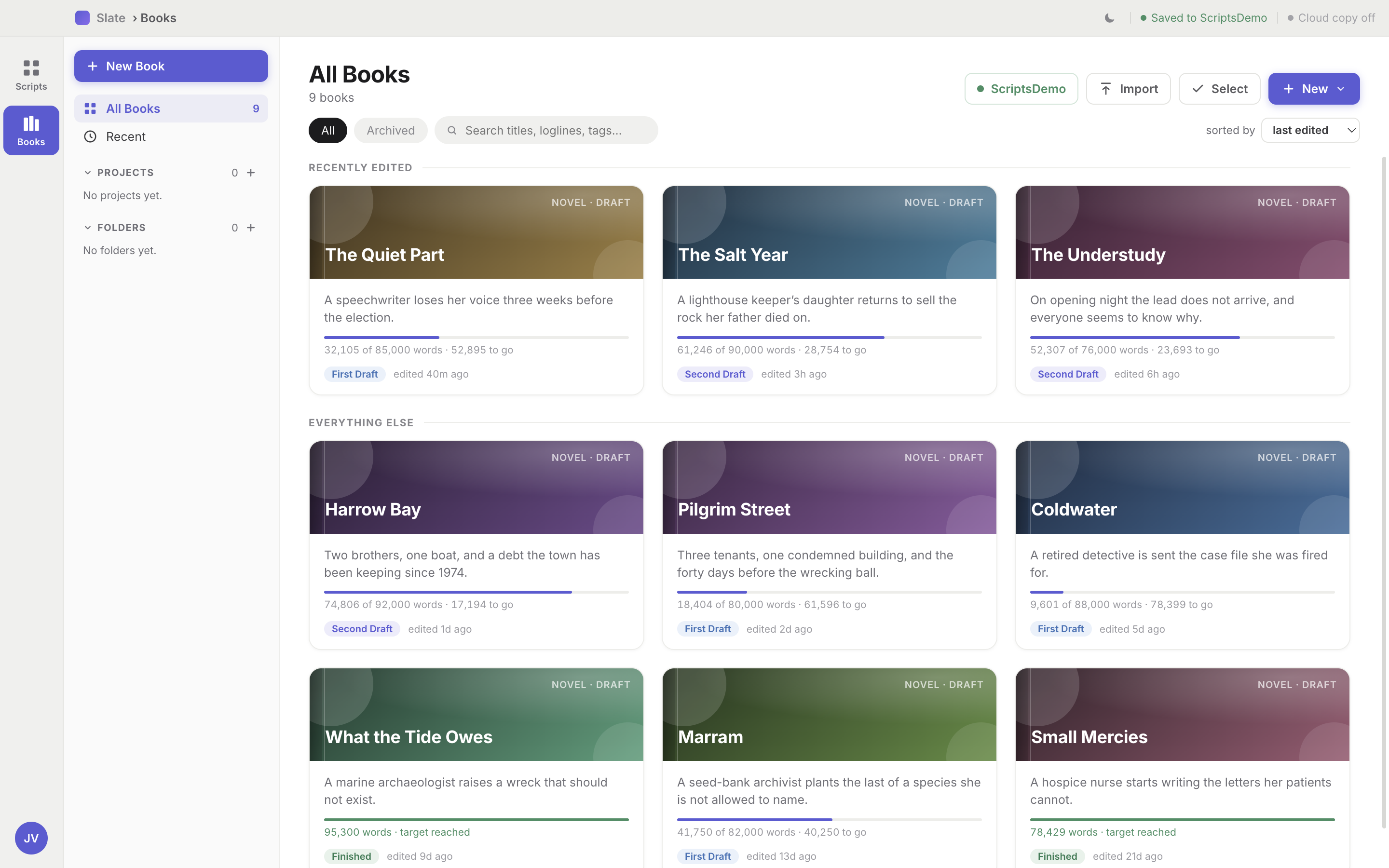
Every book carries its own word target, and the bar on the card fills as you write. It turns green when you get there.
Slate keeps the story and the pages in one place — beats, sections, and drafts all talk to each other. All of it works the same whether the document is a screenplay or a book.
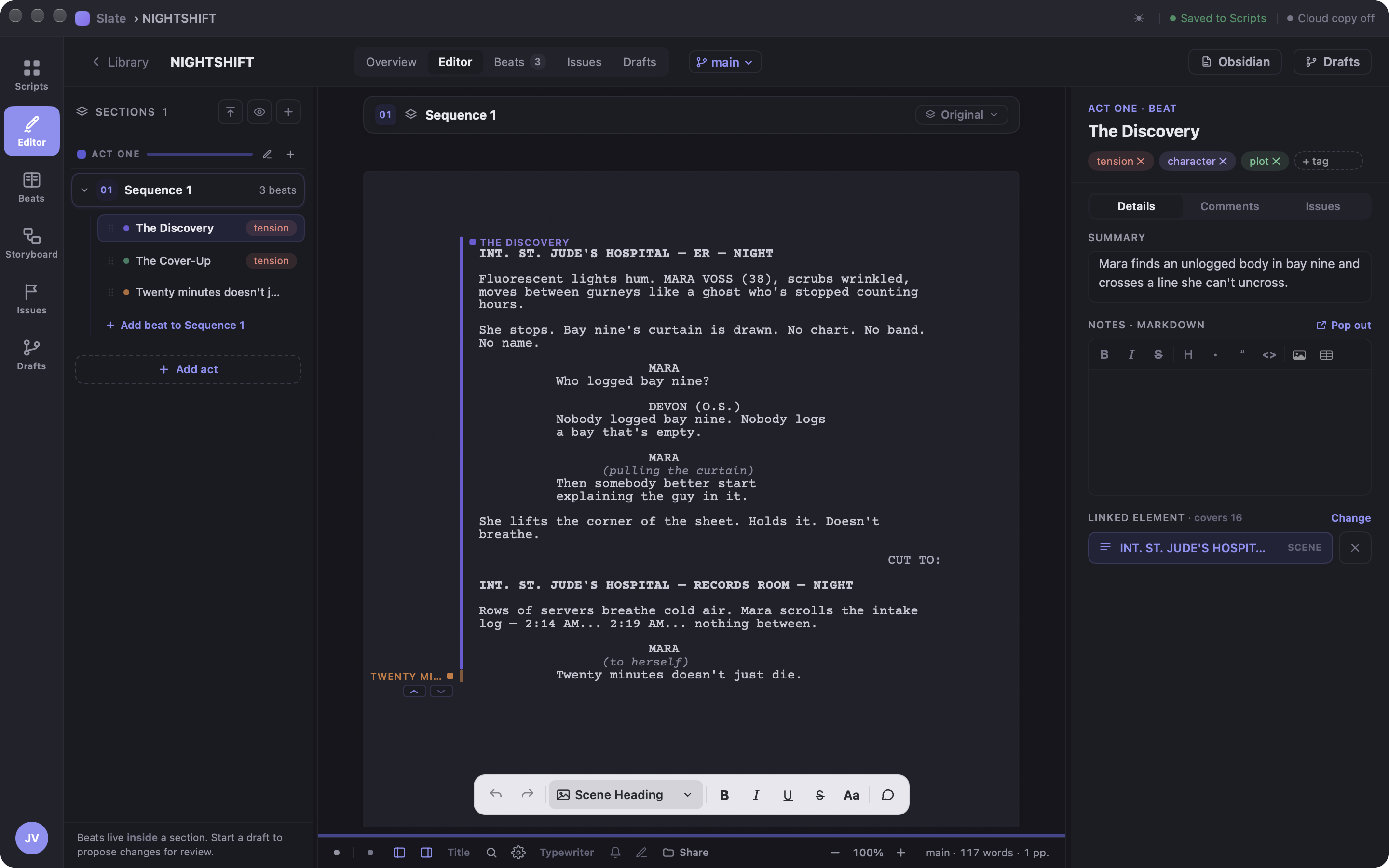
A beat isn't a sticky note somewhere else — it's linked to the actual lines it covers. Tag it, summarize it, keep director's notes and comments beside it. When the scene moves, the beat moves with it.
⌘⇧B on any line turns it into a beat.
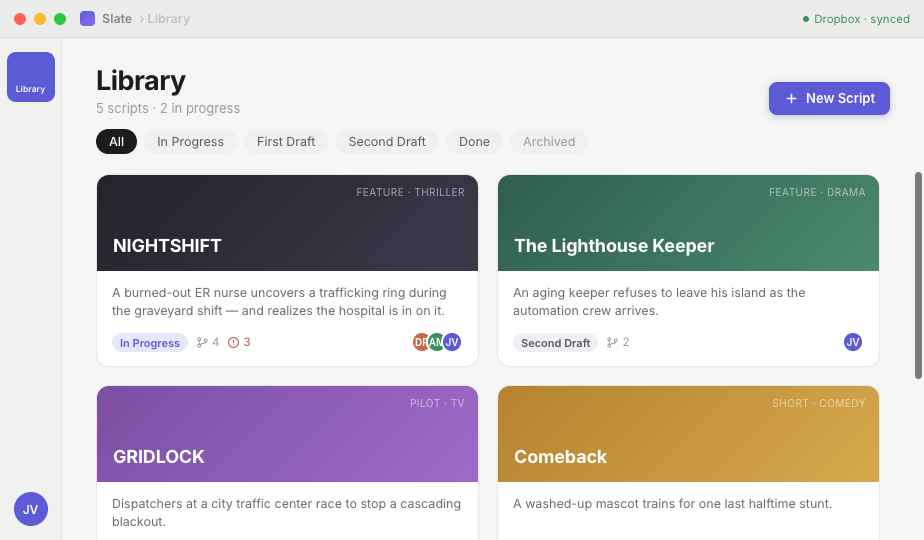
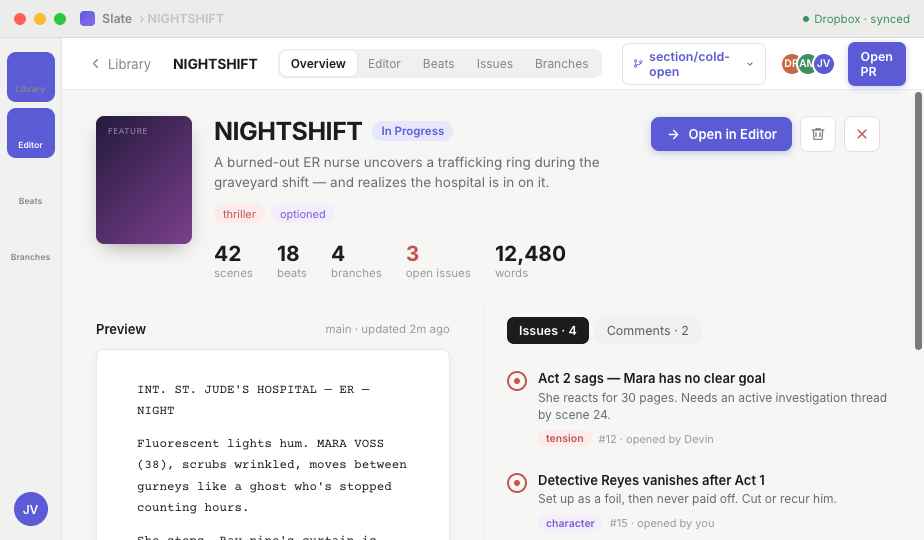
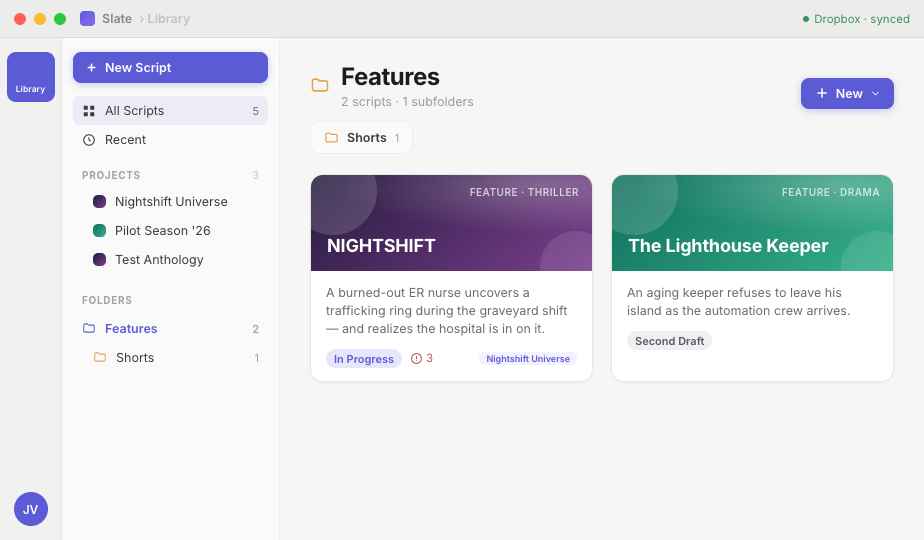
Every script — and every book — gets a cover, a logline, and a status: To Do through Finished, renameable to match how you actually work. The overview page shows scenes or chapters, beats, drafts, and open issues at a glance. Organize with folders and projects, save locally with a second copy in any cloud drive, export a script to PDF or Fountain — and every book keeps a Markdown twin on disk.
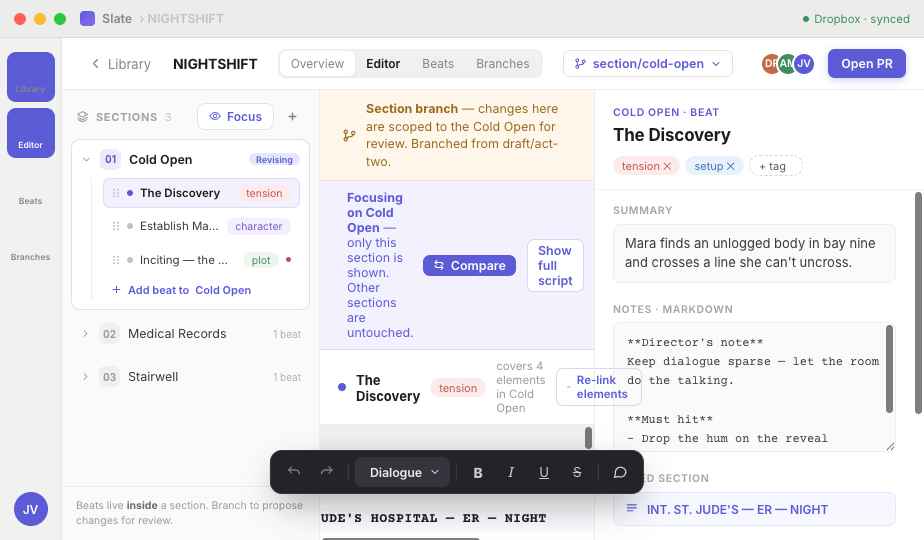
Split the script into a cold open, acts, a stinger — or a book into chapters and the scenes inside them. Focus on one section while the rest holds still, keep alternate versions of it side by side, and scope a whole draft to just that section when one scene needs surgery.
The whole story on one board — beats as cards, acts as columns, or chapters if you're writing a book. Drag a beat somewhere new and its pages travel with it. It's the corkboard, except the index cards are wired to the pages.
Software teams have had this for decades; writers got "Save As". Here's the whole system, in four moves — the same four whether you're on page 30 of a pilot or chapter nine of a novel. Click through:
Your script lives on "main" — one clean, current version. Every save is a moment you can come back to.
Want to try the bolder cold open? Start a new draft. The original stays untouched while you experiment — the whole script, or just one section.
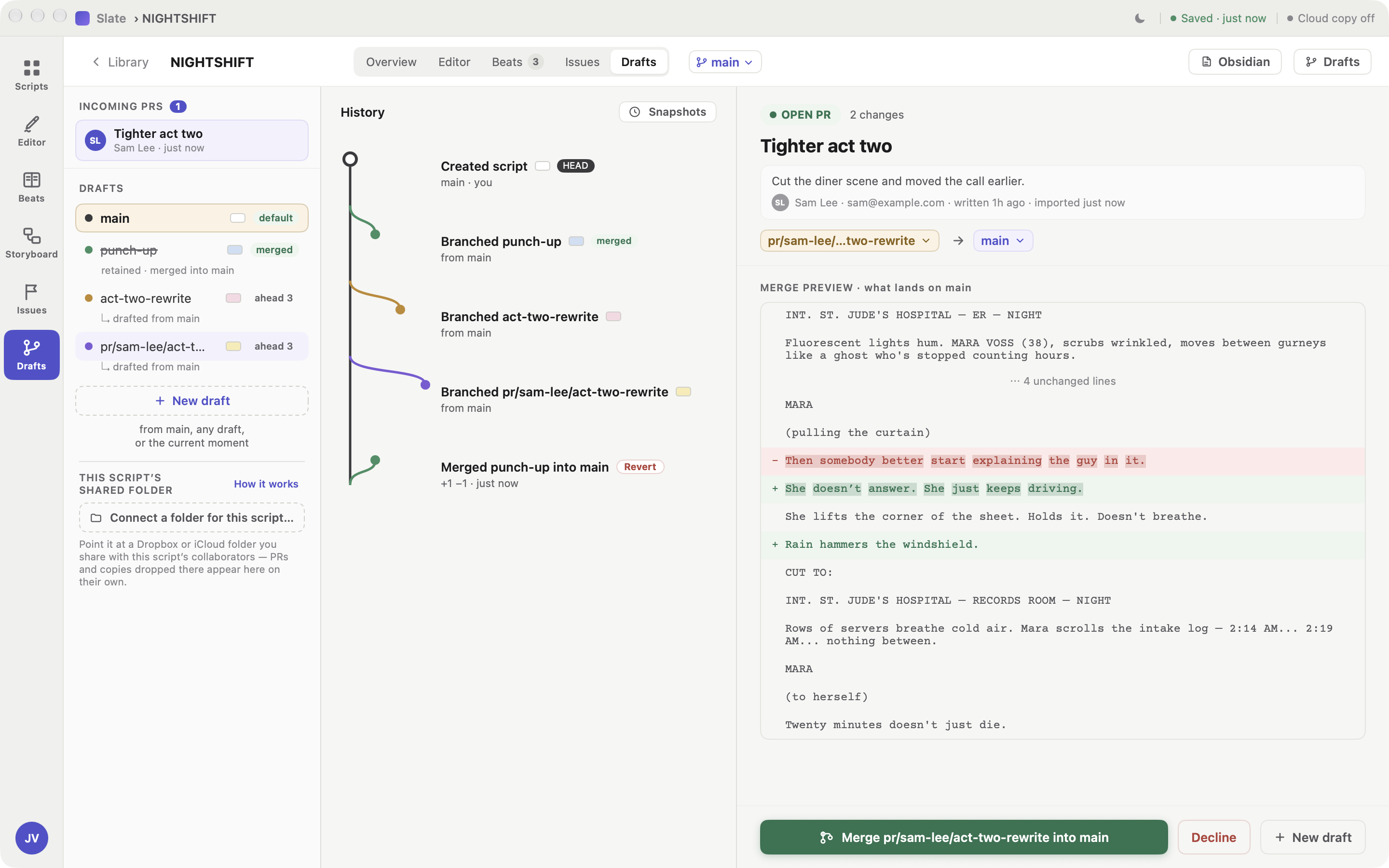
Your co-writer works on their own draft and sends you a proposed revision — you read it like notes, not like a surprise.
Compare the two side by side, keep what sings, and merge. One script. No version-seven-final-final.
Cut lines in red, new lines in green — two drafts side by side, so "which version is better?" is finally a question you can see.
Instead of both of you typing over one another, a co-writer works on their own draft and sends it over when it's ready. You read the whole change, leave comments in the margins, and merge it when you're sold. You always have the final cut.
Point a script at any shared folder — Dropbox, Google Drive, or any shared cloud provider. Everyone's drafts live beside the script; proposals flow through the folder. Your pages never sit on someone else's server.